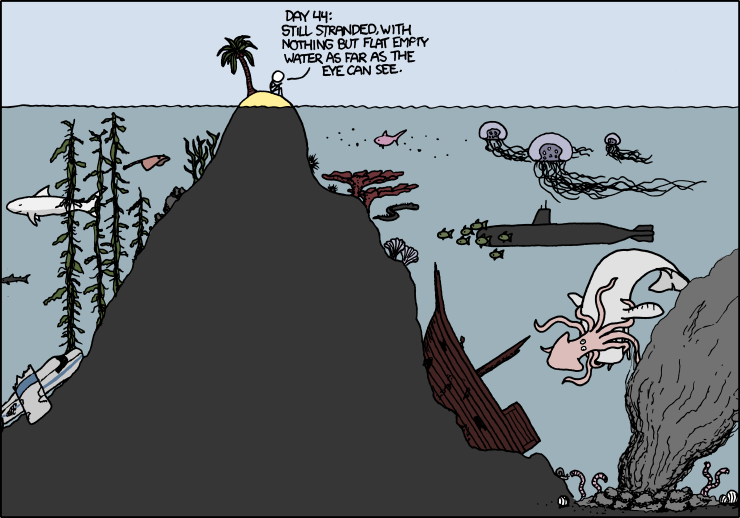
I've now mostly caught up from being away for 3 weeks and have gotten over the 12 hour jet lag. So, really, I have no more excuses not to post something. Luckily from me, Deep Sea News had a great post to day on what it takes to be a deep sea biologist. I'm a little afraid that I'm revealing too much about myself, as obviously gone through all of their points to fully embrace the insanity of deep sea biology. Here's #1:
"Love and Pain…Like Sunshine and Rain. Welcome to
Deep-Sea Science. Before you start, you better realize what exactly you
are heading into. Deep-sea science can be both extremely rewarding and
extremely heart breaking. To be a deep-sea scientist is to be one part
scientist, one part explorer, and three parts masochist. The logistical
difficulties and financial requirements of sampling an environment
covered with miles of water will pretty much make every project you want
to do either impossible or close to it. While other graduates students
and scientists in your department drive a truck down to their field
site and take samples till the cows come home, you will be having a
nervous breakdown because of insufficient data. A project that takes
other scientists a weekend and $250 to do will take you three years and
$250,000. So, deep-sea science is not for the faint of heart. However,
if you can manage to get a chance (which likely will not happen), then
you will probably discover something new, a species, a habitat, a
process, or a biological adaptation. Deep-sea science is a young field
compared to many other science disciplines. You will never be at a loss
for questions, because most of the answers are still unknown. Too bad
you won’t be able address all of them. I write this with
tongue-in-cheek of course, but I am serious. This is a tough field and
doing deep-sea science isn’t easy. Think about this for some time
before you move to number 2."
#2 - 11 found here http://deepseanews.com/2009/03/so-you-want-to-be-a-deep-sea-biologist/
Thursday, February 28, 2013
Wednesday, February 6, 2013
Adapt to this...
Part of what I'm in Indonesia to do is to review a marine program which includes efforts to help Indonesian coastal communities adapt to climate change. Most of the effort is focused on rural villages on remote islands. I must say, it makes for good site visits.... do you sense the but? Here it is... but there's a HUGE problem in the urban areas.
While Jakarta looks like its headed towards Panem with the huge shopping malls and high fashion, its still a third world, developing city. I've already experienced the open sewers, ad hoc landfills and 100% unsafe piped water, but today was another adventure.
An hour or two of rain. That's all it took to cause massive gridlock (in an already congested traffic pattern) due to flooded streets. After waiting 30 min for a taxi we ordered from the hotel (all of the taxis are full when in rains), we decided to trek it. We waded through ankle to mid-calf high water for about a mile to get to our hotel.
The water itself wasn't an issue - just standing water, no current - as long as I didn't think about what was IN the water. I mention the open sewers, right? Eww. The bigger issue was that the sidewalks and streets are in such disrepair, you never knew if you were about to step in a giant hole. I also kept imagining a car going my and splashing us - like in the movies. But the cars weren't going fast enough to get more than a wave going. Luckily, we made it back to the hotel with no twisted ankles... just wet and with shoes that should likely be tossed out.
As a colleague at USAID said... "Welcome to Jakarta."
While Jakarta looks like its headed towards Panem with the huge shopping malls and high fashion, its still a third world, developing city. I've already experienced the open sewers, ad hoc landfills and 100% unsafe piped water, but today was another adventure.
An hour or two of rain. That's all it took to cause massive gridlock (in an already congested traffic pattern) due to flooded streets. After waiting 30 min for a taxi we ordered from the hotel (all of the taxis are full when in rains), we decided to trek it. We waded through ankle to mid-calf high water for about a mile to get to our hotel.
The water itself wasn't an issue - just standing water, no current - as long as I didn't think about what was IN the water. I mention the open sewers, right? Eww. The bigger issue was that the sidewalks and streets are in such disrepair, you never knew if you were about to step in a giant hole. I also kept imagining a car going my and splashing us - like in the movies. But the cars weren't going fast enough to get more than a wave going. Luckily, we made it back to the hotel with no twisted ankles... just wet and with shoes that should likely be tossed out.
As a colleague at USAID said... "Welcome to Jakarta."
Monday, February 4, 2013
Meetings in Jakarta
The first thing that I learned about Jakarta was that physical displacement was HARD to do. Often you could walk to meetings faster than you can drive... that is if there were sidewalks and it wasn't 85-90 degrees plus 90% humidity, oh and yeah, the air pollution (though I'm told that its leagues better than it was 10 years ago). I learned my lesson the hard way... I was nearly late for my first meeting.
I took 45 min to go 2.5 miles; and then tack on another 10 minutes to get an elevator... and I was a couple minutes late for a meeting at the UN. Luckily it was an informal meeting and we ended up at Starbucks in search for air conditioning.
First, you might be asking why we were on the search for AC. Well, the UN's AC was out due to electricity problems following the massive floods in Jakarta after a rivers spilled over and flood gates had to be raised. Luckily for me, most of the flooding had receded by the time I arrived, but we still took some taxis through a couple of questionable streets in both Jakarta and then in Kendari.
Second, you might be thinking... Starbucks? Yes, in many ways it was like taking a different mix of ethnicities and throwing them into a city in the USA. Starbucks, McDonalds, KFC, Burger King, Ace Hardware, Gap, Banana Republic, and the list of familiar names goes on and on. The defining differences between Jakarta and a US city, the traffic is a little worse than say DC or LA, but really its the slums two blocks away that surround the skyscraper islands. Its a strange mix of modern and traditional, economic growth and adverse poverty. Thus is Jakarta... an embodiment of the two worlds of Indonesia.
After learning my lesson about the speed of physical mobility in Jakarta, I planned better for meetings across town with USAID, the Indonesian government, and with our "partners". "Partners" in USAID speak means the companies and NGOs to which we give money to actually implement the development activities. I'm not good at names and I've even worse when they're names I don't know. Its a good thing I've been collecting business cards... though I'm worried I'm running out of my USAID cards!!
All and all it was a long and crazy week in a Jakarta.
| Brown flood waters fill the streets of central Jakarta |
First, you might be asking why we were on the search for AC. Well, the UN's AC was out due to electricity problems following the massive floods in Jakarta after a rivers spilled over and flood gates had to be raised. Luckily for me, most of the flooding had receded by the time I arrived, but we still took some taxis through a couple of questionable streets in both Jakarta and then in Kendari.
Second, you might be thinking... Starbucks? Yes, in many ways it was like taking a different mix of ethnicities and throwing them into a city in the USA. Starbucks, McDonalds, KFC, Burger King, Ace Hardware, Gap, Banana Republic, and the list of familiar names goes on and on. The defining differences between Jakarta and a US city, the traffic is a little worse than say DC or LA, but really its the slums two blocks away that surround the skyscraper islands. Its a strange mix of modern and traditional, economic growth and adverse poverty. Thus is Jakarta... an embodiment of the two worlds of Indonesia.
After learning my lesson about the speed of physical mobility in Jakarta, I planned better for meetings across town with USAID, the Indonesian government, and with our "partners". "Partners" in USAID speak means the companies and NGOs to which we give money to actually implement the development activities. I'm not good at names and I've even worse when they're names I don't know. Its a good thing I've been collecting business cards... though I'm worried I'm running out of my USAID cards!!
All and all it was a long and crazy week in a Jakarta.
Sunday, January 27, 2013
Wakatobi
| Enjoying the sunrise before our dive. |
It was encouraging that the government appears to be committed to marine conservation. We toured the construction site of a new academy (similar to vocational school) dedicated to marine conservation practice. It was an impressive building. May be this child waiting on the stairs for his mom or dad to finish construction for the day will be a pupil in the new school.
Thursday, January 3, 2013
First TDY
TDY - Temporary Duty; Temporary Duty Yonder, Testis-Determining Factor on Y, Temporarily Divorced for a Year, Typically Developing Youth. (Dictionary definitions of TDY)
The world of the USG (U.S. Government) is filled with acronyms, often with out definitions. I think what I'll be doing is the first definition, which will hopefully not lead to the second to last definition. For all intensive purposes, here, TDY will mean a three week trip to Indonesia.
This trip could mean:
Days on end in a room (I hope is as nice as) this:
or days spent visiting sites like this:
Likely it will be mostly option number 1, but I'll be happy if I get any of option number 2... and it sounds like I might. There is at least one day that says 'snorkel/diving' on our itinerary. It does make sense that we would check out the marine resources that the programs are working to conserve, preserve and utilize to improve peoples' lives.
I've been told that this rarely or never happens on a TDY for our office. But I've also heard the same thing about high profile projects... so we'll see what happens!! I'll at least get a better sense of how our work is translated 'on the ground'.
The world of the USG (U.S. Government) is filled with acronyms, often with out definitions. I think what I'll be doing is the first definition, which will hopefully not lead to the second to last definition. For all intensive purposes, here, TDY will mean a three week trip to Indonesia.
This trip could mean:
Days on end in a room (I hope is as nice as) this:
or days spent visiting sites like this:
Likely it will be mostly option number 1, but I'll be happy if I get any of option number 2... and it sounds like I might. There is at least one day that says 'snorkel/diving' on our itinerary. It does make sense that we would check out the marine resources that the programs are working to conserve, preserve and utilize to improve peoples' lives.
I've been told that this rarely or never happens on a TDY for our office. But I've also heard the same thing about high profile projects... so we'll see what happens!! I'll at least get a better sense of how our work is translated 'on the ground'.
Sunday, December 2, 2012
Human dispersal and fish
Fallen democracies, civil war, and overall conflict. What do these have to do with fisheries, aquatic ecosystems, and dispersal? At times... everything.
During World War II, fishing effort drastically plummeted as ships and men were repurposed to fight in the war. This resulted in a double blip in fish catches -- a drop during the war and an increase in size and numbers after the war when fishing resumed. In ecological terms, the top predator had to allocate resources to survival which decreased predatory pressure... additionally, the top predators were dispersed to other parts of the world.
I had the privileged to meet a researcher, Cullen Hendrix, from William and Mary who along with Sarah Glaser has made strides in establishing the connection between conflict and fish beyond just the WWII 'blips'. Globally, when there is sustained conflict reported fish catches decrease. However, unlike WWII, Cullen and Sarah found that fish catches did not rebound to exceed or even meet ore-conflict levels until decades after resolution of conflict. There are many possible reasons for this lag - illegal and unreported fishing in poorly patrolled waters, destruction of infrastructure or capital (such as piers, boats, nets, etc), and my favorite... loss of human capital through the dispersal/migration of people.
There are some exceptions. It is possible to have the opposite effect. If conflict displaces refugees towards a coast, distant conflict can indirectly create an increase in fishing pressure and thus fish catch.
These drastic changes in fishing pressure due to conflict can have ripple effects through the ecosystems. As far as I can tell, exactly how the ecosystems react to temporary changes in human dispersal during conflict is a wide open question with fascinating implications for the economic and environmental costs of conflict.
Cullen S. Hendrix and Sarah M. Glaser. (2011) Civil conflict and world fisheries, 1952-2004. Journal of Peace Research. 48: 481-495. (link) (pdf) **Awarded the Nils Petter Gleditsch Journal of Peace Research Article of the Year Award, 2011**
I had the privileged to meet a researcher, Cullen Hendrix, from William and Mary who along with Sarah Glaser has made strides in establishing the connection between conflict and fish beyond just the WWII 'blips'. Globally, when there is sustained conflict reported fish catches decrease. However, unlike WWII, Cullen and Sarah found that fish catches did not rebound to exceed or even meet ore-conflict levels until decades after resolution of conflict. There are many possible reasons for this lag - illegal and unreported fishing in poorly patrolled waters, destruction of infrastructure or capital (such as piers, boats, nets, etc), and my favorite... loss of human capital through the dispersal/migration of people.
There are some exceptions. It is possible to have the opposite effect. If conflict displaces refugees towards a coast, distant conflict can indirectly create an increase in fishing pressure and thus fish catch.
These drastic changes in fishing pressure due to conflict can have ripple effects through the ecosystems. As far as I can tell, exactly how the ecosystems react to temporary changes in human dispersal during conflict is a wide open question with fascinating implications for the economic and environmental costs of conflict.
Cullen S. Hendrix and Sarah M. Glaser. (2011) Civil conflict and world fisheries, 1952-2004. Journal of Peace Research. 48: 481-495. (link) (pdf) **Awarded the Nils Petter Gleditsch Journal of Peace Research Article of the Year Award, 2011**
Thursday, November 15, 2012
A new lens
A S-event, congressional hearing, a National Geographic Symposium, a myriad of interagency meetings and briefings. Its been a crazy two weeks and I was only peripherally involved in the frenzy surrounding wildlife crime in DC this week. I'm assured that this stuff never happens in our office. Its not often that the Secretary (S) of State becomes passionate about a conservation or biodiversity issue.
I don't know if all of this high profile attention will translate into action and progress on the ground, but I have started to see conservation and biodiversity differently.
I have spent my scientific career studying marine processes to improve our understanding of the world around us. I've stayed away from conservation per se - partially after seeing too many hippies pedaling hemp to save the earth growing up in California and partially because of a deep seeded value for curiosity. I had never thought about the broader implications of preserving biodiversity and the environment. Of course its a good thing... but not just for the sake of the environment. How is it that the crazy hippies didn't ever convince me - a biologist, a believer in the environment - that a healthy and protected environment is essential for our national security, global economy, and health. Now it shouldn't have to be about humans, but there might be a lot more buy in if it was.
National Security. What does conservation have to with national security? We'll start there since its been integral to the wildlife events the past two weeks. A testimony to Senate and House Reps of the International Conservation Caucus painted a grim picture not just of rhino's horns being cut off and elephants slaughtered for the skyrocketing price of ivory but of a growing, untraceable monetary supply for terrorist groups. With other revenue streams successfully being closed off, rebel and terrorist groups are turning to the lucrative business of poaching in developing countries with poor environmental protection and enforcement. Well-run wilderness (marine, forest, savannah, or other) preserves coupled with stable local communities surrounding them will not only save species but might close off a revenue stream to ... well, bad people.
World peace through environmental conservation? Not quite but a necessary step in the right direction.
I don't know if all of this high profile attention will translate into action and progress on the ground, but I have started to see conservation and biodiversity differently.
National Security. What does conservation have to with national security? We'll start there since its been integral to the wildlife events the past two weeks. A testimony to Senate and House Reps of the International Conservation Caucus painted a grim picture not just of rhino's horns being cut off and elephants slaughtered for the skyrocketing price of ivory but of a growing, untraceable monetary supply for terrorist groups. With other revenue streams successfully being closed off, rebel and terrorist groups are turning to the lucrative business of poaching in developing countries with poor environmental protection and enforcement. Well-run wilderness (marine, forest, savannah, or other) preserves coupled with stable local communities surrounding them will not only save species but might close off a revenue stream to ... well, bad people.
"From al-Shabaab to the brutal Lord’s Resistance Army, we are seeing the worst of the world’s worst poaching elephants to fund their illicit activities," said Rep. Royce. "... The transnational aspect of the illegal wildlife trade and the demand from Asia has elevated this problem from an ‘African problem’ to a global problem. There are dangerous terrorist connections. It is time we target these networks engaged in the illegal wildlife trade."
World peace through environmental conservation? Not quite but a necessary step in the right direction.
Monday, November 5, 2012
VOTE!!!
I'm foreboden from discussing politics at work, and I'll keep that pledge here. The most important thing is to VOTE.
Its a strange thing being entrenched in the policy side of the government during a major election year. If there's a change in the White House, science and foreign policy will likely get a big overhaul. Aside from the intangible policy, people will be in flux. Political appointees may or may not disappear in the next few months. A few are already set to leave no matter what.
Right now last minute (midnight hour) policies are being pushed through for VIPs to leave their mark or stamp on the landscape. My office is all in a tizzy trying to push through multiple 'action items' before the upheaval. I am quite excited that at least a couple of the VIP causes will help conserve wildlife and the environment!
Its a strange thing being entrenched in the policy side of the government during a major election year. If there's a change in the White House, science and foreign policy will likely get a big overhaul. Aside from the intangible policy, people will be in flux. Political appointees may or may not disappear in the next few months. A few are already set to leave no matter what.
Right now last minute (midnight hour) policies are being pushed through for VIPs to leave their mark or stamp on the landscape. My office is all in a tizzy trying to push through multiple 'action items' before the upheaval. I am quite excited that at least a couple of the VIP causes will help conserve wildlife and the environment!
Monday, October 22, 2012
In the Public Eye
I just entered into the arena where science and policy come together - applying science for public good. I'm still very much in the midst of learning the culture, what I can and cannot say (aka how and when to censor myself), and figuring out what I'll be doing. At the same time on the other side of the world, six scientists were just convicted of poorly communicating the uncertainty of science in the public sphere. Six geoscientists did not predict an earthquake or 'accurately communicate' the potential earthquake hazard. This does not inspire confidence as I start navigating this new realm.
We had 2 weeks of orientation - oriented to leave out the caveats when giving a message to the Hill. There's not time nor the desire by the audience to go through the uncertainties. At the same time, we were told to tell it how it is... within the confines of the audience and time limits. It's a difficult line to find - concise, clear and decisive, but scientifically complete. I knew I had to learn how to hit the right balance. Now I'm a bit scared of what might happen if I miss.
There are numerous articles, blogs, comments, etc discussing the trial and verdict. I don't know the intricacies of the trial nor the exact words said before the earthquake, so I do not try to presume the 'correct' verdict. However, only hours later, there are already profound effects rippling across the scientific community. It is not only me, a small player in a pond, that is questioning their role and willingness to put themselves out into the public... its really too bad, because I also see a lot of opportunities to help society and help the environment.
We had 2 weeks of orientation - oriented to leave out the caveats when giving a message to the Hill. There's not time nor the desire by the audience to go through the uncertainties. At the same time, we were told to tell it how it is... within the confines of the audience and time limits. It's a difficult line to find - concise, clear and decisive, but scientifically complete. I knew I had to learn how to hit the right balance. Now I'm a bit scared of what might happen if I miss.
There are numerous articles, blogs, comments, etc discussing the trial and verdict. I don't know the intricacies of the trial nor the exact words said before the earthquake, so I do not try to presume the 'correct' verdict. However, only hours later, there are already profound effects rippling across the scientific community. It is not only me, a small player in a pond, that is questioning their role and willingness to put themselves out into the public... its really too bad, because I also see a lot of opportunities to help society and help the environment.
Friday, October 19, 2012
Introductions
I had a month hiatus due to personal reasons - I wish I was off to some fabulous vacation, but no such luck. The hiatus is over though. This was my first week in another new and foreign discipline and another government agency - US Agency for International Development (USAID). Its still 'development' but in a very different vein. Its also ecology but in a different context. Going to NIH, I went from large-scale biology to small-scale biology. Now, I'm scaling back up even larger than before - a more complete ecosystem which includes humans and all of their institutions.
The week didn't start off well though. I hope its not a sign. My first day... My first staff meeting... I descend the longest escalator in the DC metro system to board my train to my new job. Only problem - someone decided that they were having a bad day (or year) and jumped in front of a train half an hour before I got there. The red line was DELAYED while they were investigating the incident. I was patient, having included an extra half an hour to get there. Finally a train came to pick us up after at least 10 min waiting. Yeah. Two stops were completely normal and then we stopped... and stopped. After 12 min sitting at a station with the doors open (total delayed time now ~25 min of my 30 min buffer), I gave up and got a cab. After walking to the cab stand, negotiating payment type, and then driving back towards the metro stations, the train still hadn't moved. Of course, we hit traffic once we got into downtown DC. I finally got dropped off in front of the Ronald Reagan Building - my new place of work. I finally made it through visitor's security and was escorted to the meeting. I was 7 minutes late. Ugh. Luckily, two people came in after me and my new mentor.
The rest of the week has been full of logistics, meetings that I mostly to somewhat understand, and gathering reading assignments. Overall, I think its been a win - I got badged (giving me access to the building and my office without an escort attached to my hip); I can access my computer and have a new email address; and I have contributed a possible new idea towards the office's research portfolio. The best part though was getting out of the metro station this evening, after my first week, and seeing a full rainbow against retreating grey storm clouds. A gorgeous end to my first week.
The week didn't start off well though. I hope its not a sign. My first day... My first staff meeting... I descend the longest escalator in the DC metro system to board my train to my new job. Only problem - someone decided that they were having a bad day (or year) and jumped in front of a train half an hour before I got there. The red line was DELAYED while they were investigating the incident. I was patient, having included an extra half an hour to get there. Finally a train came to pick us up after at least 10 min waiting. Yeah. Two stops were completely normal and then we stopped... and stopped. After 12 min sitting at a station with the doors open (total delayed time now ~25 min of my 30 min buffer), I gave up and got a cab. After walking to the cab stand, negotiating payment type, and then driving back towards the metro stations, the train still hadn't moved. Of course, we hit traffic once we got into downtown DC. I finally got dropped off in front of the Ronald Reagan Building - my new place of work. I finally made it through visitor's security and was escorted to the meeting. I was 7 minutes late. Ugh. Luckily, two people came in after me and my new mentor.
The rest of the week has been full of logistics, meetings that I mostly to somewhat understand, and gathering reading assignments. Overall, I think its been a win - I got badged (giving me access to the building and my office without an escort attached to my hip); I can access my computer and have a new email address; and I have contributed a possible new idea towards the office's research portfolio. The best part though was getting out of the metro station this evening, after my first week, and seeing a full rainbow against retreating grey storm clouds. A gorgeous end to my first week.
Subscribe to:
Posts (Atom)