Friday, August 17, 2012

In the field

Deep-sea coral snapped during a
SCUBA dive. (c) Rhian Waller
All of my friends seem to have such exciting lives! Check out Dr. Rhian Waller diving in Fjords in Chile in search of deep-sea corals living near the surface. Dr. Anna Michel is stomping around Alaska with a super fancy laser to measure changes in atmospheric composition.  (No, the laser is not attached to a shark. Too bad, I know.)

Dr. Michel conquering the Alaska wilderness.
Someone at NIH once asked me why I gave up such a cool job diving to the bottom of the ocean and finding new, strange species for... well NIH? I had very specific reasons - I wanted to learn molecular techniques at a cutting edge facility to bring back to marine sciences; I wanted to decrease travel for a while, so I could be with my kids while they were young. And I've accomplished what I set out to do. I have two wonderfully annoying kids and learned far more about developmental biology and molecular biology than I thought I would. Its about time to start putting a toe back in the water. 

I'll do some traveling with USAID. I don't know where but likely to some island nations and Southeast Asia. Not too shabby. The bonus will be that I'll also be helping the people there. I'm hoping to get some proposals submitted and funded during the next year, so I can get back into the big blue head first in 2014. There's something inexplicably beautiful about the sea spray smacking you in the face while you drop thousands of dollars of equipment into the water... hoping that you'll bring up something new and exciting.

Thursday, August 16, 2012

Loose Ends

Advice to all of us in temporary positions or really ANY position... start keeping protocols and inventories as early as possible and as organized as possible. Fight the urge to put off organizing all of your reagents and work. There's always a new experiment to run, but the loose ends will come back to haunt you later. And now I'm at the end... the later... I should of learned this after my graduate school experience, but some how its not the same -- field ecology/oceanography and molecular biology. 

Molecular biology has WAY more protocols, solutions, reagents, etc, etc, etc. The next few weeks will be spent sifting through catalog numbers, gene ID numbers and a freezer full of clones, probes and 5 years of work. Its amazing how much of that will literally be thrown away.

I guess it could end up being a cathartic process... like burning your notebooks at the end of school year or after graduation. It always made for a great bonfire.

The process brings home, like no other, that this phase is over. I'm moving on. Forward. For now, its just a couple metro stops away to a new realm - policy. Then its to start my own lab... scary but very exciting!!

Thursday, August 9, 2012

Job Search - my one regret

Though by the end I was getting tired, I actually enjoyed almost all of my interviews. Its a joy to meeting new people doing great science who are also interested in your own science. What can I say? I like talking shop... especially since I've been at NIH where I get fewer chances to do it.
There was really only one regret I have - 'the diversity seminar'...

I applied to all sorts of job ads - integrative biologist, biological oceanographer, marine ecologist, ecologist, modeler, and a very unique ad for Diversity in Marine Sciences. I have participated in many different outreach and 'diversity' programs throughout the years to promote my own research career and to help others in theirs. However, I never thought that it would translate into helping me get a job so directly. Still, I applied and actually got an interview at a top tier place. Wohoo!

It wasn't a bad interview but it was strange because no one really knew about the position. I had 'interviewees' ask me what they should be looking for. I had to give a research seminar, which I rocked, and then a modified chalk talk. The chalk talk was to consist of two portions - 1) contributions and plans to increase diversity and 2) research plans and goals. This is where my regret comes into play.

I can make excuses (I had a sinus infection. The committee wasn't clear on their expectations for the diversity plans. etc. etc.) but it comes down to the fact that I didn't deliver. I had a plan from which I deviated... to my own demise. I didn't practice it enough to know the important points I needed to drive home and which ones could be skimmed over. I hadn't thought enough about it in depth. I've always contributed to diversity efforts and even been a recipient, but not in a planned way.

One great thing about interviewing is that you ARE forced to think about what is important to you, where you want to go with your work and really life. Although it is crazy, stressful and hectic, there is a lot of time that must be devoted to reflection and personal goals to be successful. As such ideas spring forth and priorities clarify. I regret not taking that time. I don't regret the outcome of my search in anyways. I think Rutgers is the right place for me in many many ways... but still I would have liked to have put my best foot forward throughout the entire process.

Thursday, July 26, 2012

Job Search: The happy outcome

Done... over... FINALLY!! I have signed on the dotted line - okay it wasn't dotted but solid line doesn't quite sound right. It was a long journey, but the end result was worth it. I am now a new Assistant Professor at Rutgers Institute of Marine and Coastal Sciences... well I will be in Sept 2013.

I'm really excited... mostly because I think they actually get me. There's a tradition of deep sea research, a contingent that brings cutting edge molecular approaches to oceanography, and a core of people that consistently work across disciplinary boundaries. The institute was set up this way from the get go. A pioneering deep-sea biologist founded the institute and purposely created a small (relative to other major oceanography institutes) but elite faculty housed under one roof, removing any physical barriers to collaboration. I look forward to making that roof part of my new academic home.

Monday, July 16, 2012

Job search - Advantage of Order


The Usual Suspects... its always the one at the end.
Percentage of offers from interviewing first = 0%, middle = 0%, end = 100%. All of my job offers, thus far have come from the places I went last or very near the end.

Everyone said, go first or go last. The first one sets the bar. The last one is freshest in their brains.  I guess I just didn't set the bar high enough... or it wasn't memorable enough... or maybe its a coincidence. The other common denominator was a broad job description for the places I've gotten offers - any marine science or biological oceanography. So 'fitting' the job ad wasn't an issue.

Granted, it is only an n = 13 and for one person... but its enough that my new superstition is to always go last.

Anyone have any additional data to add?

Thursday, July 12, 2012

Job Search - the worst interview

I've been on quite a whirlwind adventure interviewing. Of course, there were the places that impressed, and there were a couple that fell short.

The first short coming was when I got into my temporary residence late at night to find a twin bed from (I swear) the 1920s awaiting me. I haven't slept in a twin since middle school. I'm not exactly tall (a nice average 5'5"), but my feet were still dangerously close to dangling off the end of the bed. The bed also had a nice bi-level appeal with one half significantly lower than the other from years of people 'sleeping'. Needless to say it was not the most pleasant few nights, and no doubt I wasn't on my best game in the morning.

The bed is relatively minor compared to my actual worst interview. Though, I did come to gauge my chances based on how well I slept the night before and the temperature and pressure of my morning shower.

To the worse interview... First misstep - the invitation to interview for ... huh... "which position did you apply for?" This should have been my first sign that all was not well. Indeed, it didn't get better from there.

This was my one and only interview in which I flew out (or drove out) the day of the interview, per their instructions.  I believe this is generally a bad idea - flight delays, traffic, weather, etc. The one good thing about the interview was that the trip out was smooth.

If at all possible, someone should pick you up at the airport - saves taxi fare and saves the candidate hassle. I was not picked up when I arrived at 11 am. I made my way to a cab and to the hotel where I was informed that the cabbie didn't have any change. Are you kidding? What cabbie doesn't have $4 in change? So a $13 cab fare became a $20 cab fare. Hello, ripping off your customers.

I rang my host to let him know I had arrived and to figure out lunch plans (11:30 am). He had not made any lunch plans, because apparently I don't need to eat... but I did have a 1 pm meeting with the dean.  We could squeeze something in beforehand. Unfortunately, a 12:15 pick up in a new jag convertible from the hotel and a 15 min drive to the dean meant that we were still late after quickly scarfing down a burger and my hair was a disaster.

Apparently, the meeting with the dean and an evening seminar were the only things planned for the day. We roamed the halls searching for someone for me to talk to. I ended up in one 'interview' over the copy machine for 20 min. Another meeting consisted of 10 mins of discussion followed by 15 mins of a discussion between the interviewer and a student.

I'm generally a go with the flow gal, but this was getting ridiculous. The second day was an improvement, but there was really no where to go but up... and it was still pretty bad.

Dinners were well attended though. Each dinner consisted of a lively bunch consuming multiple courses and copious amounts of alcohol. It was like port call after a cruise, so it brought back good memories of debauchery in my youth. However, I felt rather miffed when after two dinner bills over $750, I was informed that transportation 'on my side' was my responsibility.  They wouldn't pay for my parking ($36) or mileage to the airport ($30). Note to the search committee - it helps to keep a candidate happy. Instead of inviting 10 people to dinner, inviting 8 and reimbursing the candidate would have been the better route and cheaper!

And to end the interview with a bang, I arrived to the airport to be informed that my seat had been given away and that I was put on standby for the next flight. I had a lovely flight stuck between two larger gents who had been on holiday, arriving back home just late enough to miss tucking my kids in bed.

Sigh.

I'm glad that most of my interviews were enjoyable. Only one bad apple in the barrel.

Monday, July 9, 2012

Science careers: More scientists, less jobs

The Washington Post ran an article over the weekend, U.S. pushes for more scientists, but the jobs aren't there, that has sparked quite a bit of discussion - sciencey and political. I'll stay away from politics for a variety of reasons and stick to a more science perspective focused on the latter part of the title.

First off, for those of us on the job market... duh!! We didn't need a headline to tell us this. We know the job market is tough. It seems like many grad students have gotten the message as well.

A group of students at an interview at a highly ranked school asked me why I wanted to come there.  I mentioned the great resources - people and facilities. Then I said that I would feel more comfortable training people with a brand name like University X behind them. I have moral dilemmas about training new cohorts of scientists that don't have anywhere to go. Where you were trained and with whom matters in today's competitive market. You need every advantage you can get.

To my surprise, the students were surprised by my answer. 'We've never heard anyone on the faculty talk about this.  We, of course, think about it all the time.'

One of my fellow postdocs is purposefully leaving academia, not because he can't hack it, but because he refuses to train students in this context.

So, are faculty really that ambivalent? Are they the slave drivers the Post article makes them out to be - using cheap labor as hands in the lab for the benefit of their own career? I (maybe naively) like to think that they are neither. Faculty benefit from successful students. It is in their own best interest to help their students thrive and land a great job.

Maybe the problem is that training can no longer be focused on academia as an end goal. So many professors are (or seem to be) set on the pursuit of academia is the only option. Of course, the stars will rise and have that option... But with only 14% of PhDs within 5 years of degree landing a faculty position (stats from Post article), students must be prepared for other career tracks. The analytical skills help in this regard, but its not enough.

Heck, grad students at many universities aren't even trained well to be professors - what about personnel management skills, budgeting, grant writing, project management, curriculum development? Essentially, a professor runs a small business and also teaches. To run that business, the prof must 'sell' themselves and their science in grants, presentations, and publications. If you want to get into high impact journals you need to tell a story. The usual summary of literature search, methods, results and dry discussion won't do it. I'm surprised at how few students are taught how to sell their science.

These more 'practical' skills are often overlooked, but can be very translational to other venues -- consulting (project management & budgets), policy ('selling' science), K-12 education (teaching), industry (project management), etc.


Above all, I believe there needs to be a shift in culture from preparing students to become professors to preparing them to contribute to society in multifaceted paths. Once this can be accepted, I think the career development support will come - new networks, translational skills, etc. And with it, the ivory tower may forge new collaborations with policy makers, industry, government, education sectors, and endless other places where society can benefit from scientists.

In the end, I agree that we still need more scientists (... really, more science education). A more science literate population, can only mean more appreciation (and hopefully funding) for science and an increase in innovation. They just probably shouldn't be all PhDs.

Friday, June 29, 2012

Science at home: When your science geek passes to the next generation

Andrey Rogozin | IST

Eating our second helping of salmon for the day (sushi at lunch and lox at dinner)...

4 year old daughter: "Can I have more?" [after devouring her first helping... a rarity at any dinner]

Dad: "When mercury attacks." [handing over a large slice of lox]

4 year old daughter: "Daddy, Mercury can't attack.  Its a planet."

Dad: "Why not?"

4 year old daughter: "Because planets just spin in space.  They're not alive.  Silly Daddy." [giggles ensue like only a 4 year old girl can do]


Now, as a marine biologist, I'm a bit irked that she didn't know yet about bio-accumulation of mercury in fish.  As a scientist, I'm thrilled by her thought process and her knowledge about planets. I guess I shouldn't be too sad about bio-accumulation as I have taught undergrads who didn't get it.

Into the deep - again

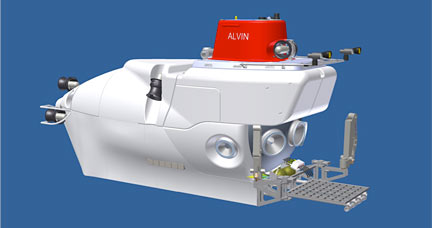
Design of the New Alvin (c) WHOI
The submersible Alvin has been out of commission for a major upgrade since December 2010. But there is progress... significant progress towards meeting the goal of test dives in December of this year!

The biggest piece of Alvin to be updated was the personnel sphere. This was said to be the only original piece left from the original Alvin of the 1960s. Now it too will be turned in for something newer and shinier. The personnel sphere is a perfectly spherical hollow ball that houses the pilot and two observers as well as oodles of electronic equipment and supplies. (picture of the sphere being made)

The new sphere was delivered to Woods Hole Oceanographic Institution today after passing its pressure tests. The original sphere was 6ft in diameter. The new one is larger. Most importantly the new sphere will increase the depth limit from 4500 m deep to 6500 m deep. To be rated to 6500m, the sphere had to pass pressure tests up to the equivalent of 8000 m (a 1500m margin for safety). Still not Cameron's feat of the Mariana Trench at about 11000 m, but this submersible is meant to be a scientific workhorse. While Cameron did include some features to allow for scientific collections, Cameron's Deep Sea Challenge can't match the scientific abilities of the research submersibles like Alvin.

We miss you, Alvin. I'm glad you'll be back in the water soon.

Thursday, June 28, 2012

Job search - the illusive 'fit'

The job search process often felt like a act of random chaos, with little rhyme or reason. In the end, I applied to 55 jobs ranging across R01 research universities, teaching colleges, policy fellowships, and even an aquarium thrown in. There was apparently enough there for quite a few search committees to throw me in the short list and thirteen wise committees invited me for an interview. I interviewed pretty much across the range to which I applied - prestigious liberal art school to R01 university, and from Hawaii to the United Kingdom. Needless to say that I've covered a lot of ground and met a lot of great people along the way.  Again, stories of some of the best and worst interviews will come... I promise... but right now whats been on my mind is that final step from interview to job offer.

I did get more than one job offer, but not always the ones I would have predicted. In quite a few places, I was able to figure out my competition. Tip: If you want to know who you're up against, look on seminar schedules; if you know someone there, ask as it is usually public information; look at posters for upcoming seminars during your visit. I'm a pretty humble person, but at least on paper, I was a stronger scientist than some of the people who were offered the job. So why doesn't the best scientist always get the job offer? ... 'FIT'

What is this ambiguous and annoyingly illusive word - fit?
[read more]