Friday, June 29, 2012

Into the deep - again

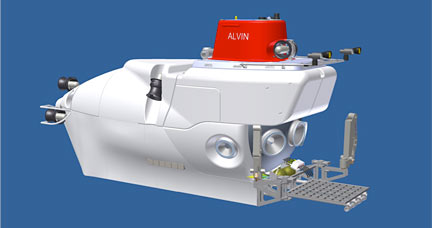
Design of the New Alvin (c) WHOI
The submersible Alvin has been out of commission for a major upgrade since December 2010. But there is progress... significant progress towards meeting the goal of test dives in December of this year!

The biggest piece of Alvin to be updated was the personnel sphere. This was said to be the only original piece left from the original Alvin of the 1960s. Now it too will be turned in for something newer and shinier. The personnel sphere is a perfectly spherical hollow ball that houses the pilot and two observers as well as oodles of electronic equipment and supplies. (picture of the sphere being made)

The new sphere was delivered to Woods Hole Oceanographic Institution today after passing its pressure tests. The original sphere was 6ft in diameter. The new one is larger. Most importantly the new sphere will increase the depth limit from 4500 m deep to 6500 m deep. To be rated to 6500m, the sphere had to pass pressure tests up to the equivalent of 8000 m (a 1500m margin for safety). Still not Cameron's feat of the Mariana Trench at about 11000 m, but this submersible is meant to be a scientific workhorse. While Cameron did include some features to allow for scientific collections, Cameron's Deep Sea Challenge can't match the scientific abilities of the research submersibles like Alvin.

We miss you, Alvin. I'm glad you'll be back in the water soon.

Thursday, June 28, 2012

Job search - the illusive 'fit'

The job search process often felt like a act of random chaos, with little rhyme or reason. In the end, I applied to 55 jobs ranging across R01 research universities, teaching colleges, policy fellowships, and even an aquarium thrown in. There was apparently enough there for quite a few search committees to throw me in the short list and thirteen wise committees invited me for an interview. I interviewed pretty much across the range to which I applied - prestigious liberal art school to R01 university, and from Hawaii to the United Kingdom. Needless to say that I've covered a lot of ground and met a lot of great people along the way.  Again, stories of some of the best and worst interviews will come... I promise... but right now whats been on my mind is that final step from interview to job offer.

I did get more than one job offer, but not always the ones I would have predicted. In quite a few places, I was able to figure out my competition. Tip: If you want to know who you're up against, look on seminar schedules; if you know someone there, ask as it is usually public information; look at posters for upcoming seminars during your visit. I'm a pretty humble person, but at least on paper, I was a stronger scientist than some of the people who were offered the job. So why doesn't the best scientist always get the job offer? ... 'FIT'

What is this ambiguous and annoyingly illusive word - fit?
[read more]

Tuesday, June 19, 2012

View into the Abyss

I've been to Brest, France once for a deep-sea biology meeting. It had been ravaged during WWII, so the architecture wasn't much to look at. The historic charm of much of France and Europe was absent. However, they do have a wonderful aquarium for those of you who are marine enthusiasts. This aquarium, Oceanopolis, now has a one-of-a-kind display - an AbyssBox. This high-pressure box can keep animals brought up from the deep alive and in view of thousands of visitors... spend millions of dollars like Cameron or without having to endure/enjoy a month long research cruise and an 8 hour dive cramped in a 6 ft sphere. True to my heart, they've chosen some vent animals to display. To learn more, check out Wired.com

I love that more people can get to see some of the wonders that I've been very privileged to experience. I still prefer the long cruise and cramped submersible dive. There's nothing like witnessing the complete environment with your own eyes. Diving on hydrothermal vents is about as close as I'll ever get to going to a different world.


Wednesday, June 13, 2012

Blogging

There are many science blogs out there. So why is mine justified? I'm not sure it entirely is, but it has been a fun and useful outlet to 1) keep me writing, 2) express my unique point of view, 3) update colleagues, friends, family and whoever else finds their way to this site on my scientific life, 4) provided some search committees with additional insight into who I am, and 5) forced me to get outside of my daily myopia.

Sushi Science and other bloggers have argued that more scientists need to blog - for their own benefit and the benefit of those who pay us, the taxpayers. That educating just 3 people more about science is worth the time. With now over 1,000 visitors (sometime in May) since inception a year and a half ago, I have hopefully sparked at least a couple of people to think about science, science careers, or life in a slightly different way. My meager 1000 pales in comparison to other blog sites with tens of thousands of visitors, but I'm okay with that. Thank you to you 1000 that have graced my blog with your time.

I'm getting ready for new journeys now. First to the US Agency for International Development, where science will be thrown into a whole new context. And then as a new faculty member. The battle for a scientific home is coming to an end and now I need to start thinking about the furnishings, landscaping, and scientific kids.

Wednesday, May 30, 2012

Diversity: Message in a Rose-Colored Bottle

A recent ScienceCareers article on the benefits for women in science caught my attention. Of course, it was by a marine scientist... but that's not why it intrigued me. Maybe step one for retaining women in science and academia is to send the right message -- Science CAN be good for women who want it all (aka family and career). So often the message is that its too hard or impossible.

from FemaleScienceProfessor
Its interesting that the man is the one
trying to balance a tenure clock and
family. If more of these 'female' issues
became male AND female issues, I believe
more progress could be made and faster.
I think I was lucky enough to get the 'right' message early.  I had many extraordinary female role models as mentors... actually almost all of my mentors have been female.  Each has chosen their own path - no kids, single mom, delayed kids, etc. None of them took my path to have kids early, but I think the diversity of paths gave me confidence that there were multiple ways to 'make it work'.

Tracy Ainsworth writes in her ScienceCareer article that "there is no best time for a scientist to have kids" ... "I have found that the inverse is also true: There is no worst time, either." I agree completely.  And I believe those words have actually come out of my mouth a couple of times - for our first kid and when we bought a house. Life doesn't go and shouldn't go on hold while you write your award winning paper, do the critical experiment, or wait for the security of a 'permanent job'. I took the leap (with my wonderful spouse) and found ways to make it work. And I'm happy to say that I have two adorable (and annoying) kids and a house in the suburbs of DC. The only things missing from the quintessential American Dream picture is the white picket fence and dog. (I have a policy of only dealing with one source of poo that I have to clean up.) We're not rich but we're happy.

It was a bit shocking to me that some students I've meet over the course of my interviews were amazed that this was even possible. It is possible. 

Friday, May 25, 2012

Climate optimist or pessimist?

I love questions after a talk. It gives me a sense of whether I got my points across and how engaged the audience was during the talk. However, a question from the audience after a recent seminar caught me a bit off guard - "So, you sound like an optimist when it comes to climate change. Why?"

photo by @jot_au
In many ways, I'm an optimist in life -- with all the ups and downs in science, I'd be depressed and probably give up otherwise -- but when it comes to the outcomes of climate change, I'd like to think I'm objective. I believe its pretty clear that there will be winners and losers. Some of the losers will likely go extinct. My bigger concern is understanding who the winners and losers will be, WHY, and what effects will that have on ecosystem function.

Obviously, we can't do experiments on every species in the world, so understanding WHY (the mechanism for persistence or frailty) is essential for predicting the fate of others. I focus on plasticity during development as a way for species to rapidly (within an individual's lifetime... often within days) respond to environmental change. I chose this because it is intimately tied to dispersal and I think it gets far less attention than other mechanisms such as range expansion, change in reproductive timing, and behavior, but could be equally important. Unfortunately for the purple sea urchin, it appears that its changes in development in response to food will NOT help it adapt to climate driven mismatches between when food is available and when larvae in the water column (Adams et al 2011, Nature Communications). 

All of the mechanisms mentioned above, with the exception of range expansion, rely on plasticity (alteration of form, function, or behavior) in one way or another. Range expansion could simply be due to increased survival at the range limits as temperatures become more optimal or tolerable for a given species.

AP Photo/Butterfly Conservation, Keith Warmington
New findings published today in Science show that range expansion can also be facilitated by plasticity. The brown argus butterfly in the UK has rapidly expanded its range to the north not just because temperatures warmed. Key to the expansion was utilizing another host plant - plasticity. During cool periods, the new host plant was not as well suited and resulted in higher caterpillar mortality. However, warmer temperatures have now made this plant a better host, boosting population growth and expanding the butterfly's range.

Many animals have these sorts of complex interactions with other species - predator-prey, parasite-host, symbiosis, etc - that can either hinder or propel response to climate change. Taking an opposing scenario for the argus butterfly - if there hadn't been an additional host plant, the butterfly's range would be confined to the spread of the range of the single host plant, even though the butterfly alone could physically tolerate more northern habitat. And for the more pessimistic view, although the butterfly's range is expanding rapidly to the north, it does not appear to be keeping up with habitat loss in the south. So this butterfly may be a "Global Change Winner" in the UK, it may be a loser overall.

Still, the story highlights the need to include multiple species interactions in our mind when considering climate change. Temperature and pH (ocean acidification) tolerances alone are not sufficient.

Its a complex story. The only thing I'm clear about is that there will be change.
Thursday, May 24, 2012

14 hours in the Hole

Yesterday was a whirlwind trip to Massachusetts for a meeting to discuss preparing a proposal.  The trip was surreal in many ways - talking about a proposal when I don't have an institution to submit a proposal through; giving a colleague and former mentor a congratulatory hug on receiving tenure that day; and having coffee at Coffee O while discussing upcoming cruises. A page out of the past and future.

Thursday, May 17, 2012

Job Search: Two down

More decisions had to be made and I now know where I'll be for 2013. Yeah. I've accepted an AAAS Science and Technology Policy Fellowship to work with the US Agency for International Development (USAID) on their Biodiversity and Forestry Team. I'll be working with international development teams around the world to incorporate biodiversity conservation within their programmatic efforts. USAID recognizes that preserving biodiversity will maintain essential ecosystem services that people around the world depend on for food, water, transport, and income. These biodiversity initiatives, training and global programs will be essential to achieve sustainable international development. For me, I hope this fellowship will allow me to directly apply my marine background to real world problems in a meaningful way. I hope to gain new perspectives on how science can affect people's lives around the world. At the same time, I hope to expand to contribute to new related areas, such as food security, where biodiversity is often underappreciated.

This doesn't mean that I've given up on a faculty position. Being a professor has been my professional goal since I was in grade school (to be precise, 7th grade when I first learned about hydrothermal vents). I still have applications pending at my top choice places. I've gotten the go ahead from them to accept the fellowship. It is a one year gig. Deferring an academic job offer for a year is not uncommon.  So in a perfect world, I can have this unique experience to gain an important perspective on the broader impacts of science AND have my dream faculty position waiting for me at the end of the year. I can only hope to be so lucky.

Wednesday, May 16, 2012

Feb 3rd Science - Part II

Long overdue.... I know.

Nuclearized β- catenin (yellow/orange) in the 
vegetal pole of a sea urchin embryo, indicative 
of active cWnt signaling. (c) McClay, Duke.
Much of my work right now involves understanding how the environment can alter development and the resulting ecological consequences for larvae. This sort of developmental plasticity could be advantageous to rapidly responding to changing environments. However, it is important that much (really most) of developmental processes are insulated from environmental signals. This is especially true early in development when the basic cell types and overall patterning are specified. It wouldn't be advantageous for your future muscle cells to become gut, for example. So understanding when and why developmental programs are either receptive to environmental signals or refractory to (insulated from) them is essential to understanding how developmental defects arise and for current research trying to artificially mimic development in a dish.

Sethi et al, Science 2012 show a beautiful example of how two of the three basic cell types in most animals - endoderm (gives rise to the gut) and mesoderm (gives rise to muscles and other cell types) - are segregated from a common 'endomesoderm' state and become refractory to external signals. This segregation is NOT a single event but is a process and progression.

A cell-to-cell signaling event initiates the process. The localized nature of the signaling event is important because it allows only the future mesoderm to receive the initial signal.

As signals often do, this alters gene expression. So often we focus on what is turned on, but here, what is essential is what is turned off. By turning off a key early endomesoderm-state transcription factor in the future mesoderm, the resulting cascade of gene regulatory interactions allows the mesoderm-specific program to run and turns off another signal (a cWnt, see image) in the mesoderm. This carves out a new mesoderm territory.

Notch signaling suppression in mesoderm.
Endoderm's reinforcing loop. (c) Science
                                                                                                                            In the endoderm, the endomesoderm-state transcription factors continue to be expressed and drive the expresssion of the cWnt signaling molecule. The endoderm factors form a reinforcing loop with cWnt signaling driving transcription factors and those factors driving cWnt expression. Thus, by turning off gene expression in one territory but not in another one, two new states are created.

We're not done yet. If cWnt signaling is inappropriately received by the mesoderm, it will initiate the expression of endoderm genes. In order to prevent this, the initial cell-to-cell signal turns on a protein that can eliminate active cWnt signaling in the mesoderm by sequestering an essential co-factor. Now, the two states are insulated from one another.

Cell-fate specification, and development in general, is not just about turning things on. What gets turned off and prevented from being turned on (through insulation from 'outside' signaling) are just as important.

So for my purposes, I'm left wondering why and how some processes are left open to external signals. When is development robust and when is it plastic? Are there ways gene are connected (business jargon: gene regulatory network architectures) that make the process more robust? -- Sethi et al show reinforcing loops and insulation from signaling as possible mechanisms. Are there ways genes are connected that make the process more plastic? -- like in organ development with multiple, dynamic signaling inputs between multiple cell types? ... We're working on it...


Sethi, A.J., R.M. Wikramanayake, R.C. Angerer, R.C. Range, and L.M. Angerer. 2012. Sequential signaling crosstalk regulates endomesoderm segregation in sea urchin embryos. Science. v335:590-593. DOI: 10.1126/science.1212867 
(Images of gene regulatory networks from Sethi et al 2012, Science).

Wednesday, May 2, 2012

Job Search: One down

The first set of decisions has come down the pipe and I ended up turning down a tenure-track position yesterday. I didn't expect to be in a position to do such a thing... the hyper-competitive job market, desire to move to a more permanent position, etc, etc. However, in the end the job offer wasn't something I could take and feel that I would be successful and happy.

In thinking about diversity and women dropping out during the postdoc stage, I thought mostly of not being able to compete given time spent at home rather than in the lab or of voluntarily dropping out because of the high work demands.

This negotiation posed another barrier. I kept thinking that this would be a fine offer if I was single. I wouldn't have to worry about my husband getting a job (not in academia... but still a job in his field) - the every popular two-body problem. Also, a lower salary wouldn't be as much of an issue without kids -- no daycare expenses, smaller house, no college savings plans, etc. And not having personnel support early on would be okay because I could work later hours to make up for it until a grant came in. But alas, I am not single without kids.

I have the apparently lofty goal of having a spouse, kids, AND a career. I've currently got all of them and I'd like to keep it that way.  We'll see if that ends up being possible or if I transition to program management, science policy or something else. During an interview, one of the students said that a professor once told him - "Spouse, kids, or career. Pick TWO." I just don't want to believe that that is the reality.  It doesn't need to be. I have some great mentors that have all three, so I know it can be done!